Showing posts with label marketing. Show all posts

Thursday, July 2, 2015

Inbound Unwound - Marketing Insights : How Do I Know If Inbound Marketing Is Going To Work?

How do you know if any of your marketing is going to work?
Ever gone to a trade show and come home with much fewer leads than you expected? Ever run an ad and received no response? How about that direct mail postcard that was supposed to deliver 2% return and only did .2%?
Any of these scenarios sound familiar? I have hundreds of stories like these from clients who, despite our advice, ran traditional marketing campaigns – only to regret the cost and labor that went into their efforts.
Is inbound marketing any different?
Yes and no. Sorry, but that’s the truth. Yes, it’s different because it's 100% quantifiable, 100% optimizable and 100% built on a methodology that matches perfectly with today’s buyer behavior. No, it’s not different because every program at every company in every industry with every client performs a little differently. Until we know exactly how it's performing, we’re only using educated guesses to predict this.
Once we get into it, though, and see what’s performing, what’s underperforming and what’s overperforming – well, that's when the magic happens. Here’s how to ensure that you see some of that magic at your company.

Predict Based On Experience

Predicting inbound marketing results isn’t easy, but it’s possible. Once you have a set of experiences, you get to see what worked and how much each of those executed tactics contributed to performance. You get an idea of how a program might perform. This experience allows you to estimate performance based on a set of assumptions, such as the idea that you’ll be able to post 12 high-quality, search engine-optimized and socialized blog articles every month.
Over time, you’ll understand how those 12 new, indexable pages help your company rank for the keywords included in them. You’ll know that increased rankings mean increased visitors. You’ll also know that once those articles are shared on other social media networks, increased visitors will come from those social sites, too. While you won’t know everything exactly, you will find out over time the difference between visitor results when you blog 12 times a month and those when you blog 10 times a month. This is very important for predicting future performance and matching that performance to program management.

Make Sure You Start With Strategy

If you want to ensure that your inbound program works as expected, start with a marketing strategy. This gives you the foundation you need to build your inbound plan on solid footing. Once you know your personas, the messages prospects need to hear, the stories you want to tell, what connects with people emotionally, how to make people feel safe, what content is required to answer their questions before they connect with you personally and what makes your business remarkable, you’re ready for inbound tactics – but not before then.

Optimize Often, Based On Data

No other marketing methodology provides as much data on the performance of marketing tactics as inbound does. Finally, you see which keywords you rank for, which blog articles are shared, which are viewed, which content is downloaded, which CTA buttons are converting, which landing pages are most popular and how many leads come from organic searches, social media or referring websites.
This information needs to be analyzed, responded to and then acted on in a timely way – within a month so that you’re able to impact performance right away as opposed to waiting three more months to see what happened and then not being able to affect results immediately. The faster your team can act on performance data, the better your results from your inbound effort are going to be.

Set Goals, Reset Goals, Manage To Your Goals

Goal setting is important, but responding to actual performance data and then resetting goals is even more important. When you set goals, you're using the data that’s available to you. As you work through your inbound program, you’re going to get new, fresher and more relevant data. This demands that you reset your objectives. Forcing your team to hit old goals based on old data is a completely unconstructive exercise.
Reset your goals monthly, and make sure that your team is working within the month to hit them. Actively managing to those goals is possible with inbound. Website visitors lagging? Try a few extra guest blogs, content sourcing, influencer outreach or posting on private networks, like LinkedIn. Leads lagging? Try to improve top landing page performance, or launch a new educational content offer. Maybe redesign the CTA buttons on your site or add a new offer to the home page. This is all reasonable work to be done in days, not months. The result is attaining your lead goals month over month.
Nothing is definite. If we all knew what was going to happen tomorrow, next week, next month or next year, we’d be doing different jobs (most likely in Las Vegas). But, that doesn’t diminish what we do know about how inbound works.
We know that the longer you stick with it, the better your results are. We know that the more activity you put into it, the better your results are. We know that the faster you pulse, the better your results are. We know that the better you connect all of the different inbound tactics, the better your results are.
We know that when compared to traditional marketing tactics, inbound marketing is the only way to create a predictable, scalable, repeatable marketing machine that drives leads for your business.

Wednesday, May 20, 2015

Inbound Unwound - Marketing Insights

Inbound marketing metrics are fantastic – but only if you take action on your findings. If you simply track for the sake of tracking and never make any adjustments to your program, do anything different or try anything new, you’re never going to realize the full potential of your inbound program.
One of the major advantages of inbound marketing is that you're able to identify what is and isn't working right now, implement adjustments to the program today and see the results tomorrow.
It's not that you’ll be 100% sure your adjustments worked, as you might need a week or month to really let your experiments run their course. But, you should get at least an indication that the results are moving in the right direction.
Specifically, consider the following workflow:
  1. Review your results daily, weekly and monthly.
  2. Analyze the data and make sure that you understand exactly what’s working like you expected and what’s not.
  3. Respond with a set of program improvements or adjustments and a set of experiments or tests designed to push the results up and to the right.
  4. Take action by installing or implementing the responses you’ve created in the Respond stage.
Then, make sure you set up the rhythms you need to keep this process going on a monthly basis, at a minimum. Here are some other considerations to make sure you take action based onmarketing metrics.

Track High-Level Performance Daily

If you’re not looking at high-level performance data daily, you’re missing the opportunity to make more course corrections more frequently. Today’s inbound marketing optimization tools come with smartphone and tablet apps that make checking the data easy – no matter where you are in the world. A quick check on visitors, conversions and leads reveals how you’re tracking versus last month or versus your goals.
If this data is down and you don’t have tactical plans to increase the numbers, you need to get a plan up and running pretty quickly. Data without action is just data.
For instance, if visitor traffic is down, you have to step up your "get found" tactics, like blogging, guest blogging, social media, email marketing and influencer outreach. If leads are not doing well, you need to step up your on-site content creation or conversion optimization efforts, or you have to make a few website upgrades to turn those visitors into leads. Almost all of these tactics can be acted upon in a matter of days, not weeks or months like some of the old, traditional marketing tactics.

Spend An Hour Each Month Digging Into The Data

There are going to be some numbers that require more thought and analysis. Schedule time – at least an hour per month – to go deep into the numbers. Look at your social reach and landing page conversion rates. These are two areas where you can see which social sites are working and which ones are lagging.
Review all of your landing pages for those that are outperforming benchmarks and those that are not. If you find pages that are underperforming, get to work making minor adjustments. Tweak the copy, add a different image or shorten the number of form fields. All of these adjustments take mere minutes, and the impact can be significant. 

Always Create An Action Plan

Once you see what’s working and what could be working better, you should take action. The action plan is the most important aspect of inbound optimization. It's the key. Create a list of 5-10 action steps, assign them to key team members, set timelines and deadlines, make sure you get an update on when the changes have been implemented and keep an eye on the metrics in real time. You should see improvements in just a matter of days – assuming the adjustments are effective, of course.
If these adjustments don’t bring about the lift you’re looking for, just rinse and repeat. Don’t be afraid to make mistakes, and don’t get discouraged if your planned improvements don’t deliver the first time. Making mistakes shows you what NOT to do again. You learn almost as much from what doesn’t work as you do from what does.
Once you get into the rhythm of Review, Analyze, Respond and Act, you’re going to start noticing a continual movement up and to the right for overall program performance. Even better, once you start to string together six, seven and eight months of this up-and-to-the-right motion, you’ll look back and see a 10x improvement in website visitors, a 5-6x improvement in leads generated and significant improvement in social reach, keyword performance and email marketing open/click-through rates.
This continuous-improvement approach is often undervalued until you look back six months and see where you were then compared to where you are today. The sooner you adopt this methodology, the sooner you start to see the results, which translates to more customers and higher revenue numbers.

Friday, May 15, 2015

7 Key Strategies That You Must Learn From Apple’s Marketing

Coming off the heels of yet another successful Apple launch debut, it’s increasingly clear that Apple is on top of their game in a way like no other. Which other company could turn an ordinary press conference into a live global event?

The secret lies beyond their product line and design standards; it lies beyond even Steve Jobs’ emphatic adherence to Apple’s core philosophy, which is that the user doesn’t always know what they want.
Looking at the company’s latest product lines and revenue models, I’d be a fool to call them anything less than what they are, which is:
  • A design firm
  • A media platform
  • A publishing company
  • A software powerhouse
  • A computer builder
  • A movement
Break down each of these bullets individually and you’ll find a company at the top of their respective industry, but combine them into a single entity and you’ve got the recipe for building one of the most influential businesses of all time.

So how did they do it?

Rather than tell you how I think they did it, I thought instead I’d turn to their fans on Twitter, who helped me uncover 7 of the greatest marketing lessons that Apple brings to the table.

1. Ignore Your Critics

As an entrepreneur, you’ll hear a lot of people tell you that you need to reach out and figure out what people want, which means listening to your critics, often times more patiently than you’d like.
Apple decides to flip the script and instead focus on building what they want to build, no matter the perceived cost. When Steve Jobs debuted the iPad, the critics stood in line, throwing every insult they could muster. The critics said that the iPad would fail. The numbers say otherwise.
Each and every time Apple decided to innovate, they were laughed at. They prevailed anyway.
“Great ideas often receive violent opposition from mediocre minds.”
- Albert Einstein

2. Turn the Ordinary into Something Beautiful

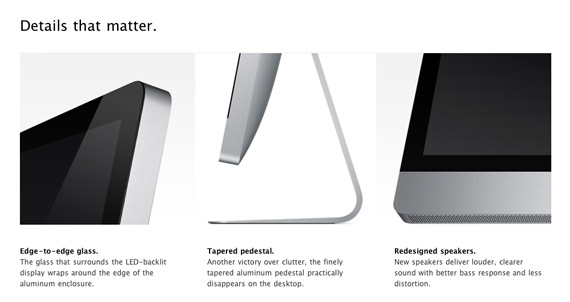
apple computer details
For quite some time, PC fans enjoyed the work of buying their own parts and building their own tower systems. At the same time, PC makers were building standard hardware for standard applications.
Apple would have none of that.
They’ve been pioneering not only the features of standard operating systems and computer systems, but simultaneously reinventing the design standards as well. As a result, we have the gorgeous iMac, the beautiful new Macbook Air, and who could forget, the amazing iPhone 4.
Where others focus on one aspect of the equation, Apple focuses on the entire product, and it shows.

3. Justify Your Price

We’re in a time when pricing strategies are all over the place. People don’t know what to charge, and in many cases, prefer to race to the bottom instead of pricing strategically to a market that can bear the cost.
Once more, Apple ignores the standard by not only pricing their technology more than 2x what their competitors charge, but doing so without blinking. How can they get away with it?
Well, the answer is twofold:
1. They build beautiful products for an audience that loves them passionately.
2. They justify their price with features and benefits that can’t be matched.
Since we’ve already hit point 1, let’s work on #2.
No other computer can match the display of a 27” iMac…it simply can’t be done.
No other software can match what iTunes brings to the table.
No laptop is as thin as the Macbook Air.
No software is more intuitive, no product more valuable than the Apple product. Any other smartphone looks like it was developed by rookies when compared to an iPhone 4. You simply cannot compare the two.
Critics will play on the fact that the core features are the same, and they might be, but that’s not the point. The point is that Apple is the Rolls Royce of the technology and design world, and their customers will gladly pay a premium because of it.

4. Communicate in the Language of Your Audience

It makes no sense to talk about things like megabytes, gigahertz, and processing power to customers that simply don’t care about technical jargon.
Take a look at any Apple product page and you’ll find that though they do discuss product specifications and technical information, it’s hidden behind the benefits that their audience is truly after.
Instead of display resolution, you’ll see phrases like “edge to edge glass,” “retina display,” and “LED backlighting.”
Sure, the jargon is there for those that need it, but it’s presented in a way that makes you want to learn about megapixels, rather than shy away from them. The art is in the copy, not in the features.

5. Extend the Experience

Have you ever heard of an unboxing? I hadn’t either until recently, when I learned that not only was I not the only one keeping Apple packaging post-sale, but that there are legions of people that record the actual process of unwrapping their newly purchased Apple products.
Do a search on YouTube and you’ll find hundreds of Apple unboxings, each from different users from across the globe. It’s pretty crazy right?
No one tells these people to video their experience, but they do it because the process is so Zen that you can’t help not to.
Apple does this by making sure that the experience doesn’t end at the cash register. They take great care in designing a user experience from browsing to unwrapping, which relies on incredible packaging and installation procedures.
By reducing installation to the lowest common denominator, they make buying new products a snap, and by spending as much time on designing packaging as they do on the products themselves, they’ve ensured that the box matches what’s inside.
As a result, they’ve built an experience that is nearly impossible to match.

6. Build a Tribe

It’s no secret that Apple has built one of the most hardcore fan bases of any product and of any time. There’s a reason they’re called “fanboys.”
But who cares, right? Most of the chatter is out of jealousy more than anything, but Apple doesn’t really care. They know that they serve an elite audience, and rather than back away from that fact, they embrace it.

7. Become “The Name”

apple iphone 4
You don’t buy tissues, you buy Kleenex.
You don’t buy MP3 players, you buy an iPod.
You don’t buy a smartphone, you buy an iPhone.
Have you noticed what they’re doing here? Apple isn’t content with being a leader in sales alone, they want to own the market itself, which explains why they’ve engineered iTunes as the major music provider that it is, and why the iPad, having the luxury of being the first, has now set the trend for future tablet devices.
From here on out, everything will be compared to the iPad, iPhone, iPod, and iTunes. Sadly, this sort of thing is tough to duplicate, but it’s not impossible. You need to have one of two things:
1. A clear head start in terms of being first to market.
2. A USP that differentiates your product in a way that makes people wish it were first.
The iPhone wasn’t the first phone, but they engineered it to be so unique that you couldn’t help but think it was. The iMac isn’t the first all in one, but it became the only one that mattered.
It’s not so much the marketing angle that matters as it is the way that people identify with that angle. Take a look at any Steve Jobs product release and you’ll watch as he tells you why every other product in the market pales in comparison to what he’s created.
You know what? We believe him.
About the Author: Nathan Hangen is the co-founder of Virtuous Giant, creator of IgnitionDeck, a crowdfunding plugin for WordPress. You can follow him on Twitter via @nhangen.